A supply line lets go behind the washer. A swamp cooler pan rusts through and runs inside the wall for a week before anybody notices. Monsoon rain sheets off a flat roof and finds the one spot the parapet flashing gave up. The water gets cleaned up, the floor dries, everybody moves on.
Two months later there's a smell in that room and the paint at the bottom of the wall is bubbling.
That gap between the water and the problem showing up is where most of our mold calls in San Juan County come from. People assume the desert takes care of it. The outside air is dry. Inside a wall cavity with wet insulation and no airflow, it isn't.
The window
24 to 48 hours. That's the EPA's guidance for drying water-damaged areas. Past that, wet drywall, carpet pad, sill plate and insulation stop being building materials and start being food. The clock starts when the water shows up, not when you get around to it.
What black mold actually is
"Black mold" usually means Stachybotrys chartarum, a greenish black growth that likes constantly wet, cellulose-heavy material: the paper face of drywall, cardboard, ceiling tile, wood that has stayed damp.
Here's the part most articles skip. You cannot identify mold by color. Plenty of dark growth is Cladosporium or Aspergillus, and plenty of Stachybotrys looks more olive than black. Anyone who walks in, glances at a wall and announces you have toxic black mold is guessing. A lab tells you what it is. Nobody's eyes do.
The practical answer: the species matters less than people think. Any significant indoor growth on wet building material needs to come out, and the water behind it needs to be fixed. That's the same whether the lab says Stachybotrys or something else.
Where water gets in around here
Construction in the Four Corners has its own failure points, and the same handful come up over and over:
- Evaporative coolers. Overflowing pans, cracked supply lines, a bleed-off that never got run to daylight. A cooler adds moisture by design, so a leak on top of that is a mold factory.
- Monsoon season. July through September we get a summer's rain in a few afternoons. Flat roofs pond, parapet flashing fails, and hard ground sheds water straight at the foundation.
- Crawlspaces. No vapor barrier means ground moisture wicking into the joists year round. Add one plumbing leak and the framing never dries.
- Manufactured and modular homes. Belly wrap holds water like a bathtub. A slow leak can run for months inside the floor system with nothing on top but a soft spot and a smell.
- Frozen and split lines. Uninsulated pipe in unconditioned space, a cold snap, and a break that runs while nobody is home. Our most common big-loss winter call.
- Sewer backups. A different category. Contaminated water is a health hazard on day one, and porous material that got wet is not salvageable.
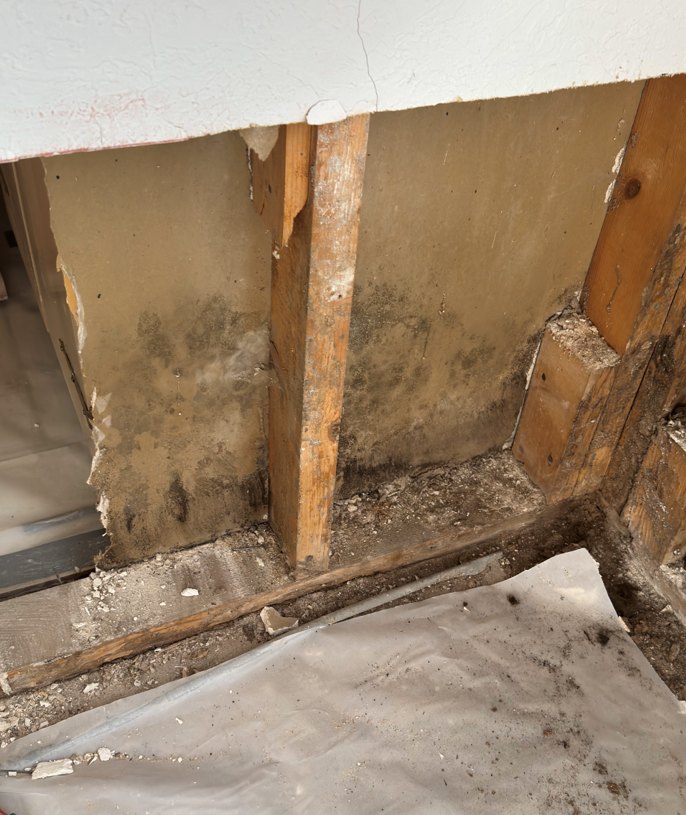
Signs the water left something behind
- Smell before sight. Musty and earthy, strongest in a closed room, a closet, or when the HVAC kicks on.
- Stains that come back. You primed and painted, and the ring is showing through again. The paint was never the problem.
- The building moving. Baseboard pulling off, buckled flooring, soft drywall low on the wall, tape seams lifting, a ceiling that sags.
- Visible growth. Speckled or fuzzy patches with feathered edges, usually in a corner, behind a fixture, or low on a wall.
- Symptoms tied to the building. Congestion or cough that eases when people leave for a couple of days and returns when they come back.
- Humidity that won't drop. Windows sweating, or a hygrometer reading over 60% indoors in a climate where that should be hard to do.
Health risks, without the hype
Indoor mold exposure is linked to upper respiratory symptoms, cough, wheeze, and asthma flare-ups. People with asthma, allergies, COPD, or a suppressed immune system react at lower levels than everyone else, and so do infants and older adults.
You'll also find claims online that black mold causes memory loss, bleeding lungs, and a long list of other things. The science there is thinner than those articles suggest. We're not going to sell a job on fear. What's well supported is enough on its own: if someone in the building has symptoms that track with being in the building, fix the moisture and get the growth out. Anyone with ongoing symptoms should talk to their own doctor. We test buildings, not people.
What you can handle yourself
EPA's rule of thumb is that under roughly 10 square feet of growth on a hard surface is homeowner territory. Detergent and water, a scrub brush, an N95, gloves, eye protection. Skip the bleach: on porous material it doesn't reach what's underneath, and paint over a moldy surface peels.
Call somebody when any of this is true:
- More than about 10 square feet, or you can't tell how far it runs
- The water was sewage or otherwise contaminated
- It's in the ductwork or the air handler
- It's inside a wall, ceiling or floor cavity rather than on the surface
- Someone in the building is immune compromised, asthmatic, very young or elderly
- There's an insurance claim, a tenant, a buyer or a landlord involved and the work needs to be documented
What a real assessment includes
Two things you can't judge by looking: what's growing, and whether spores have spread through the rest of the building. That's what sampling is for.
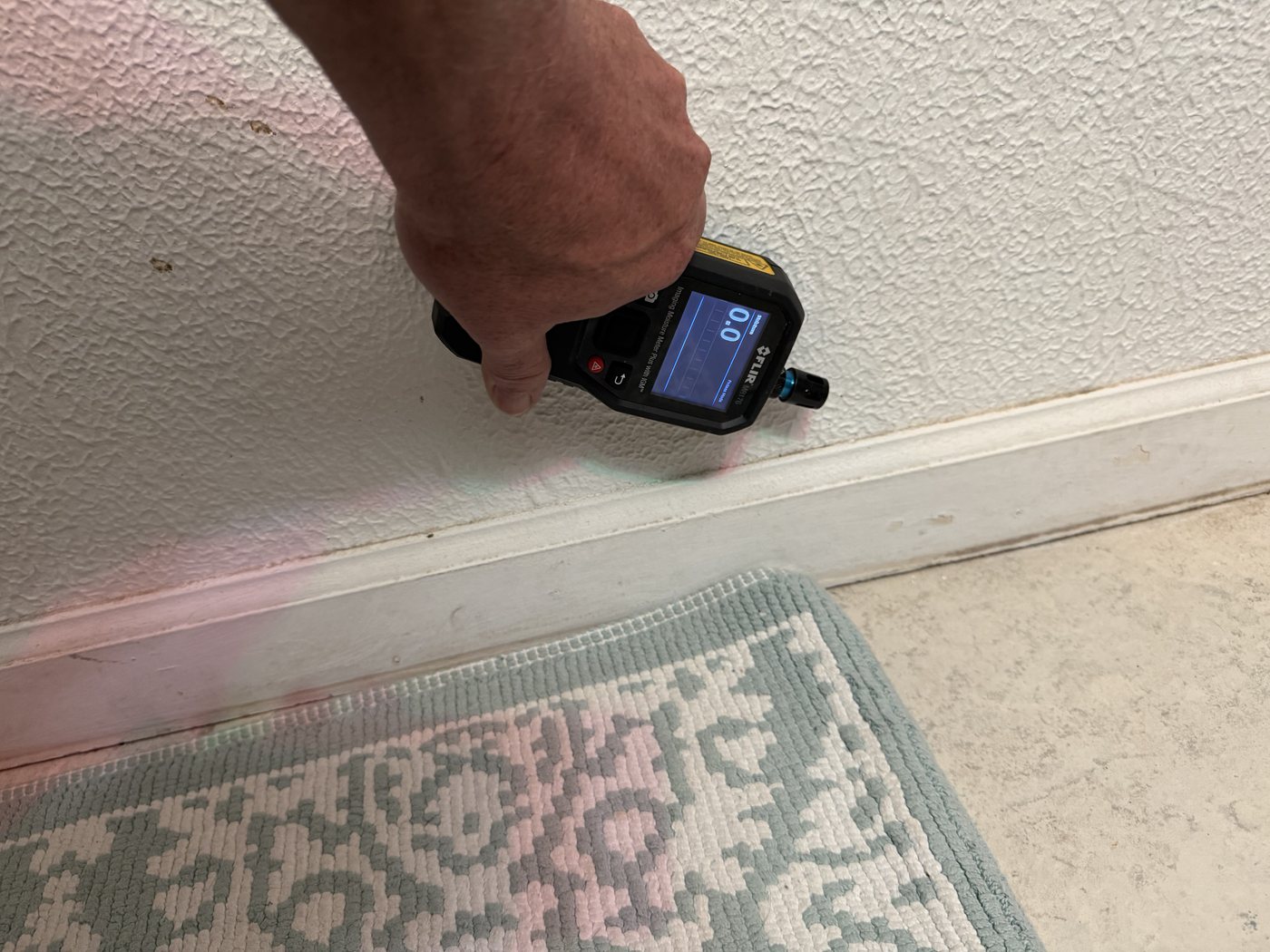
- Walk-through with moisture readings on walls, floors and framing
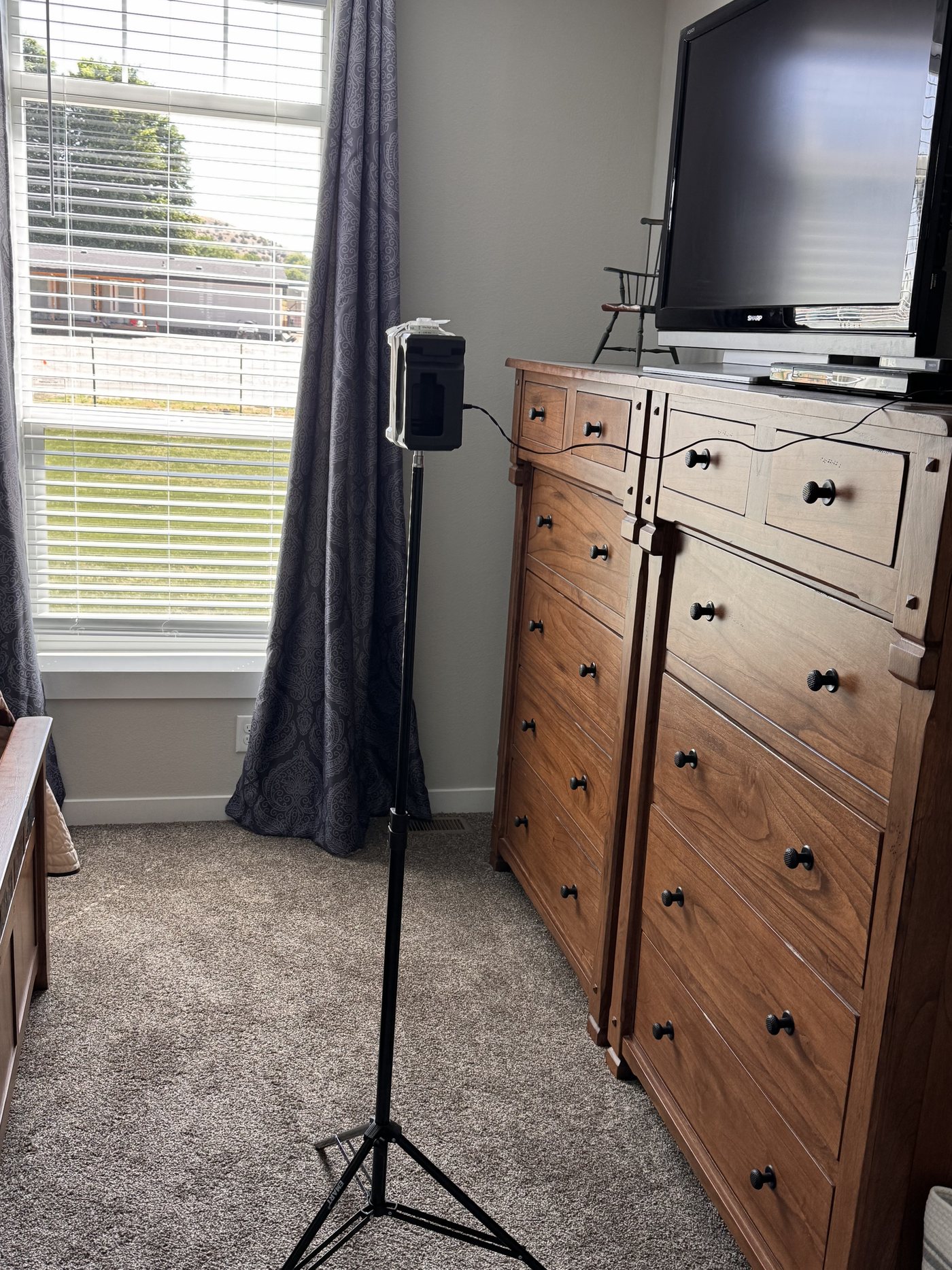
- Air samples inside the affected space plus an outdoor control taken the same day. Without the control, indoor numbers mean nothing
- Surface or bulk samples where there's visible growth
- Analysis by an independent laboratory. We don't analyze our own samples, and you shouldn't trust a company that does
- A written report with the lab data, chain of custody, and a plain-language read on what it means
- A scope and price for removal if removal is warranted, and a straight answer if it isn't
How removal is supposed to be done
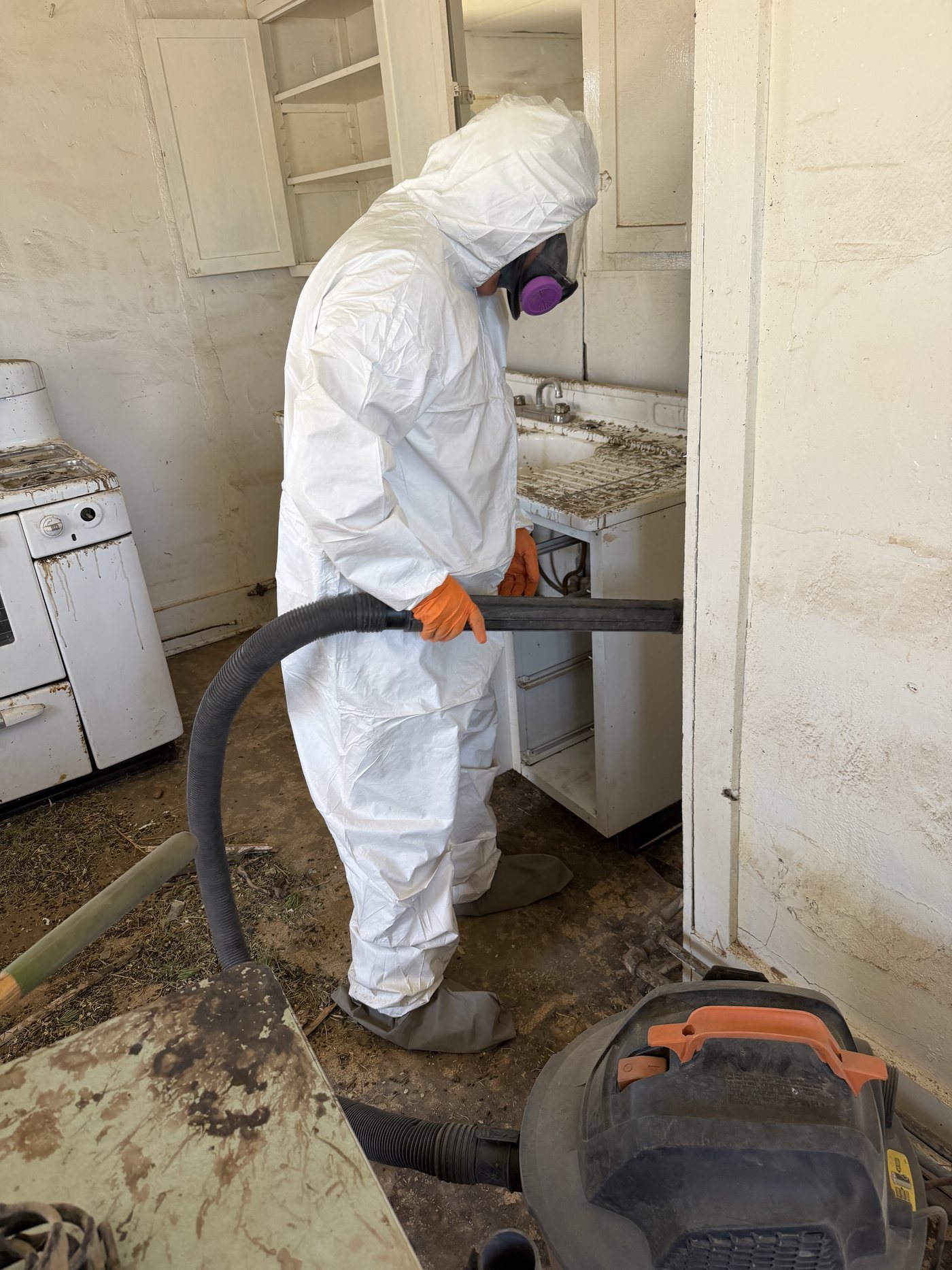
Remediation is not scrubbing a wall with bleach and setting a fan in front of it. Done right it looks like this:
- Fix the water first. Cleaning before the leak is repaired is money set on fire.
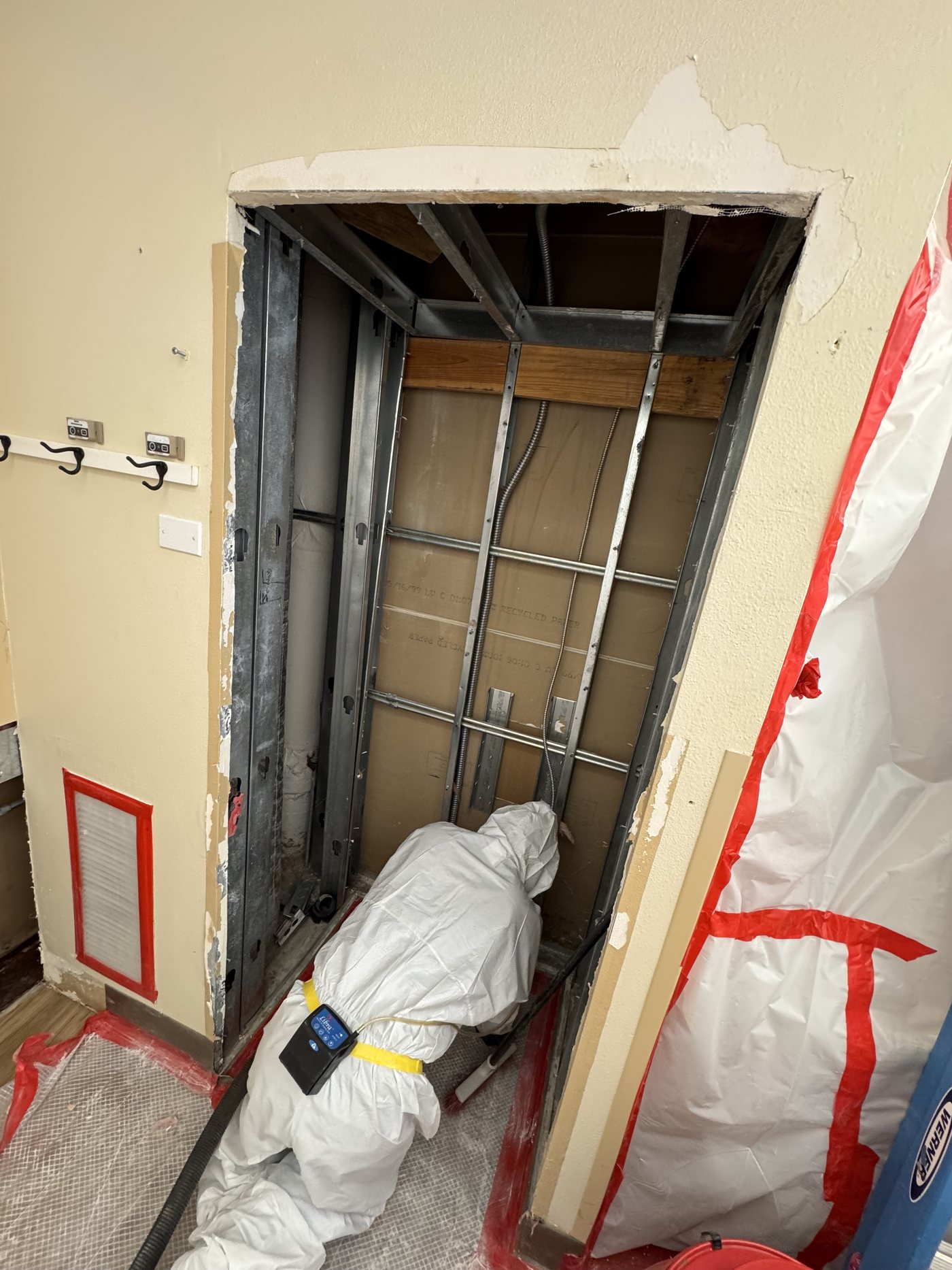
- Containment. Work area sealed with 6-mil poly, HVAC shut down or return grilles sealed, one zippered entry.
- Negative air. A HEPA-filtered machine keeps the work area under pressure so spores don't ride into clean parts of the building.
- PPE. Fitted respirators with P100 filters, suits, gloves, eye protection. Not dust masks.
- Remove what can't be saved. Affected drywall, insulation, carpet and pad cut back past the visible damage, misted to hold the dust down, bagged inside containment.
- Clean what stays. Framing and hard surfaces scrubbed and HEPA vacuumed.
- Dry the cavity. Air movers and dehumidifiers until the meters say dry, not until it looks dry.
- Clearance testing. Sample again against outdoor levels before anything gets closed up. That report is the proof.
- Rebuild. Drywall, texture, paint, trim and flooring back in.
Drying and moisture control
Drying is where jobs quietly fail. Surfaces feel dry in a day out here while the studs behind them are still wet, and closing a wall up on that means doing the job twice.
- Air movers along surfaces, not straight at them, with dehumidifiers running in a closed space. Open windows work against the machines
- Meter readings logged every 12 to 24 hours until they flatten out
- A hygrometer left in the crawlspace or utility room afterward, indoor humidity held under 60%
- Vapor barrier over crawlspace dirt, and grading that carries water away from the foundation
- Downspouts run three to four feet out, gutters cleared before monsoon season instead of during it
- Exhaust fans actually used, and dryer vents that terminate outside
Insurance and documentation
Most homeowners policies cover mold when it follows a sudden accidental event like a burst pipe or a failed water heater. Long-term seepage usually isn't covered, and many policies cap mold coverage at a set dollar amount. What helps a claim:
- Photos of the water and the damage from several angles, before anything is torn out
- Reporting to your carrier right away, in writing
- A dated log of who you called and when
- An assessment report with lab data, which is what an adjuster wants and what most homeowners don't have
- Receipts for the emergency work, since mitigation is usually covered separately from the repair
Getting it documented early also puts a date on when the damage was found, which matters if the carrier later argues the problem was gradual.
Running now
Mold assessment with air sampling — 15% off
Walk-through, moisture readings, air sampling with an outdoor control, independent lab analysis, and a written report you can hand to your insurance carrier, your landlord or your buyer.
Call or message for pricing. It depends on the size of the space and how many samples the job needs. Mention this article and we take 15% off the assessment.
Residential and commercial. Farmington, Aztec, Bloomfield, Kirtland, Shiprock and across the Four Corners. Offer applies to the assessment; removal is quoted separately.
Common questions
Can I just paint or bleach over it? No. Bleach doesn't reach growth inside porous material and paint over a moldy surface peels. Both hide the problem long enough for it to get more expensive.
How long does a mold job take? A single wall in one room is often a day or two of removal plus drying time. Crawlspace or whole-house work runs longer, and drying usually sets the schedule, not the demolition.
Do I have to move out? Usually not. Containment and negative air are what make it possible to stay in the rest of the building. If the work area is large, involves the HVAC system, or someone has a serious respiratory condition, we'll tell you straight.
Is testing always necessary? No. If you can see growth and you know where the water came from, the money is often better spent removing it. Testing earns its keep when growth is hidden, when a claim or a sale is involved, or after remediation to prove the space is clear.
Do you work on the Navajo Nation? Yes. We work across the Four Corners including tribal lands, and we handle the disposal and documentation that comes with it.
Talk to DEKON
DEKON Environmental Services is a licensed New Mexico contractor (GB-98/GS-29 #417265) based in Farmington, working across the Four Corners. If you've had water damage and you're not sure what it left behind, we'll tell you what's there and what to do about it.
Call 505-543-8083 or reach us through dekonenv.com to schedule an assessment.
DEKON Environmental Services — Where Safety and Quality Service Count!
General information, not a substitute for an on-site evaluation of your building or medical advice about your own symptoms.